

Short answer Fix a recurring slot in both timezones, pick films in advance, and keep the first one under two hours.
The reason long-distance film nights stop is never that the software was hard. It is that the fourth one required three days of messages to schedule, and somebody suggested a three-hour film on a Tuesday, and after that nobody brought it up again. The technology is the easy part and it is the part everyone writes about, so this post starts with the hard part.
Fix the slot before you fix anything else
A recurring time removes the negotiation entirely, and negotiation is what kills these. Two rules that make the difference:
- Write it in both timezones, always. "Sunday 9pm" is not a time when one of you is in Karachi and the other is in Lisbon. "Sunday 21:00 PKT / 17:00 WEST" is. Put both in the calendar invite.
- Pick the slot for whoever has the worse end of it. If one of you is watching at 1am, that person will cancel first, and they will feel bad about it. Move the slot rather than testing their commitment.
Northern and southern hemisphere clocks shift on different dates, and some countries do not shift at all. A fixed local time silently moves by an hour twice a year — which is exactly the kind of small friction that ends a habit. Re-check the offset each spring and autumn.
Pick the film before the night, not on it
Thirty minutes of browsing is how a film night becomes a browsing night. Two practices that work:
- Keep a shared list. Anywhere — a notes app, a message thread you both pin. Add to it whenever something comes up, and pick from it on the night.
- Alternate who chooses. Removes the negotiation and quietly guarantees you both watch things you would not have picked, which is most of the point of watching with someone.
One constraint worth checking before you commit: is the title in both catalogues? Streaming rights are regional and the two of you are, by definition, in different regions. A party synchronises playback; it cannot conjure a licence. Check the title exists for both of you when you add it to the list, not at 21:00 on the night.
| Check | Why it matters at distance |
|---|---|
| The title is in both catalogues | Regional rights differ, and this is the single most common last-minute failure |
| Neither of you has seen it | A rewatch is a different, quieter kind of evening — fine, but decide deliberately |
| Under two hours for the first few | A three-hour film across a five-hour timezone gap is an endurance event |
| Not subtitle-heavy if you want to talk | You cannot read subtitles and hold a conversation at once |
The five minutes of setup
Do this once, well before the first night, not while somebody is waiting:
- Both install the extension and reload any tabs that were already open.
- Add each other as friends once — sign in on the Friends tab, swap the twelve-character friend codes, accept. After that, inviting is one button rather than a copied link every week.
- Turn on push-to-talk in the toolbar popup and agree on the key.
- Do a two-minute dry run on a YouTube video. Pause, scrub, change the video, say something. Find the problems now.
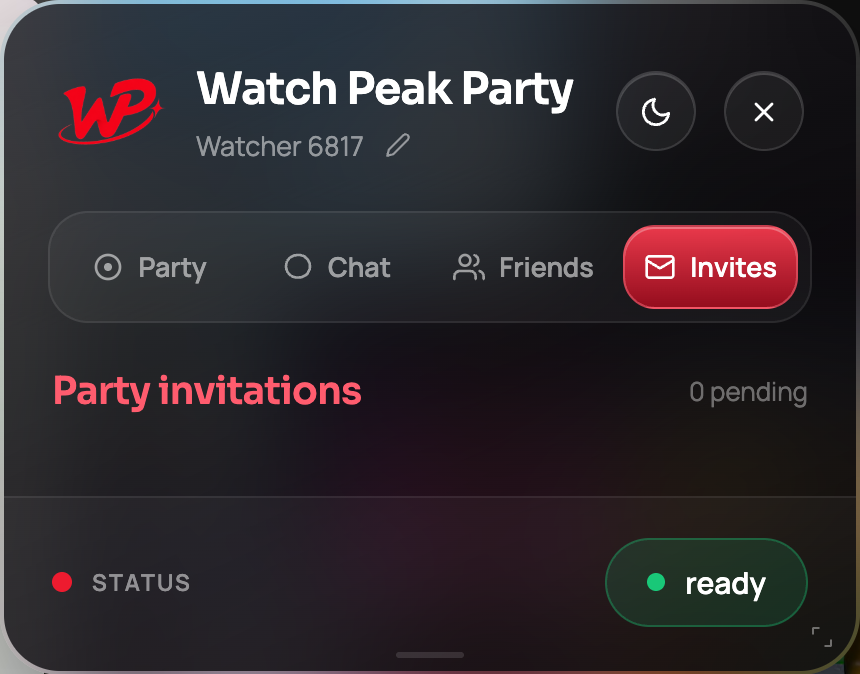
Adding each other as friends is the difference between "start party, copy link, open WhatsApp, paste, wait" and "press Invite". Over a year of Sundays that is a lot of copy-and-paste.
Planning for the bad connection
At distance, one of you will have the worse connection, and it will be the same person every time. Plan around it rather than being surprised by it:
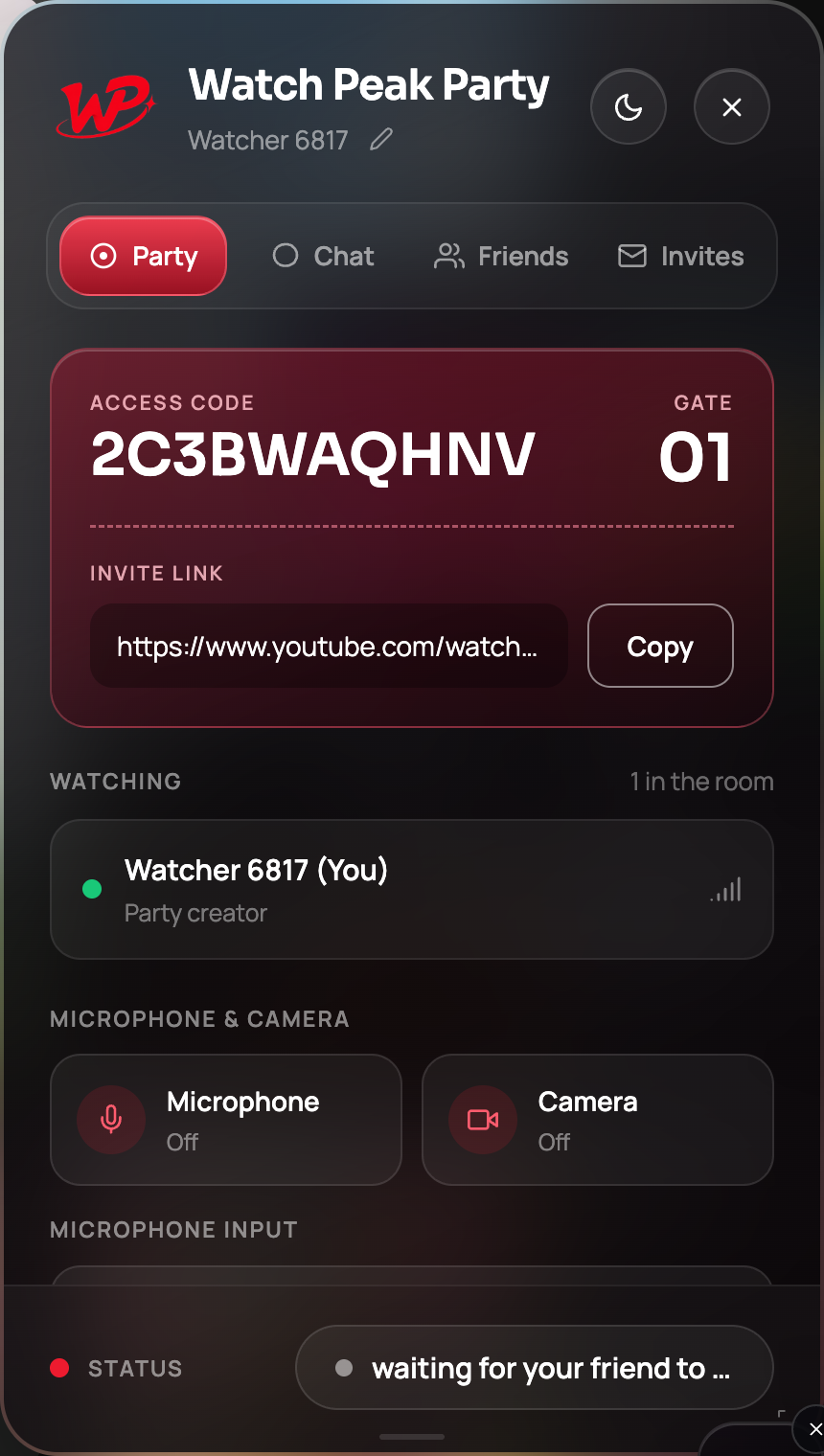
- Lower the quality on that side deliberately. Quality is per-viewer — nothing forces you both onto the same bitrate, and 1080p that never stalls beats 4K that stalls every ten minutes.
- Use chat and push-to-talk, not camera. A camera stream competes with the film for the same upstream, and the film loses first.
- Learn Sync now. One button, and it pulls you to them rather than dragging them to you — so the person who fell behind is the person who presses it.
The bit that makes it stick
Practical, and it genuinely matters: the nights that survive have a shape. A five-minute catch-up before you press play, so the film is not the only thing you did. Snacks on both sides, because eating alone at your desk while somebody else eats alone at theirs is a strange kind of together. And a rule for what happens when someone cannot make it — skip a week, do not reschedule twice, keep the slot.
Also: end the party. Press Leave party rather than closing the tab and wandering off. The conversation after a film is the part you will remember, and it is easier to have when nobody is wondering whether the other person left.
Common questions
What if the film is not available in both countries?
Then you cannot watch it together this way — a party shares a position, not a licence. Check availability when you add a title to the list, not on the night.
How do we handle a big timezone gap?
Set the slot for whoever has the worse end of it, write it in both timezones, and keep the first few films under two hours.
Should we use the camera?
On a constrained connection, no — it competes with the film for upstream bandwidth. Push-to-talk and chat cost much less.
Do we need to send a link every week?
No. Add each other as friends once and the weekly invitation is a single button with a notification on their side.
What happens if one of us drops out mid-film?
Re-opening the invite link rejoins the same room. The party does not have to be started again.
One link. Same second. No screen sharing.
Watch Peak Party keeps YouTube, Netflix, Prime Video, Crunchyroll, Disney+, Hulu, HBO Max and JioHotstar in sync — with chat, voice and video built in.
Add to Chrome