Short answer Pick something with gaps in it, decide camera or no camera up front, and use push-to-talk.
A film is a strange first choice for a date because it is, by design, a period in which you do not talk. In person that works — you are in the same room, and proximity does the work that conversation would. Remotely, proximity is exactly the thing you do not have, so the silence has to be designed for rather than hoped through.
Pick something with gaps in it
The choice of film does more work here than any setting. What you want is something with natural openings — moments where a comment is expected rather than intrusive.
| Works well | Why |
|---|---|
| A comedy | Laughing together is the cheapest shared reaction there is, and it needs no words |
| Something one of you loves and the other has not seen | Gives one person a licence to say things, and the other something to ask about |
| A famously bad film | The entire text is commentary. Impossible to have an awkward silence |
| A documentary | Pauses are welcome and questions are natural |
| Harder than it looks | Why |
|---|---|
| A subtitled film | You cannot read and talk at the same time — see the anime post |
| A dense thriller | Any comment costs someone the plot |
| A three-hour epic | Ninety minutes is plenty for a first one |
| A rewatch of a favourite | Fine, but expect them to be watching you enjoy it rather than enjoying it |
Camera or no camera
This is the real decision, and there is no universally correct answer — but the trade is clear.
Camera on gives you the reactions, which for a comedy is most of the value. It also means two hours of being visible, which is tiring, and it competes with the film for the same upstream bandwidth — on an ordinary connection the film degrades first.
Camera off, push-to-talk on is the setting most people end up at. You hear each other when there is something to say and nothing in between, and both streams stay clean.
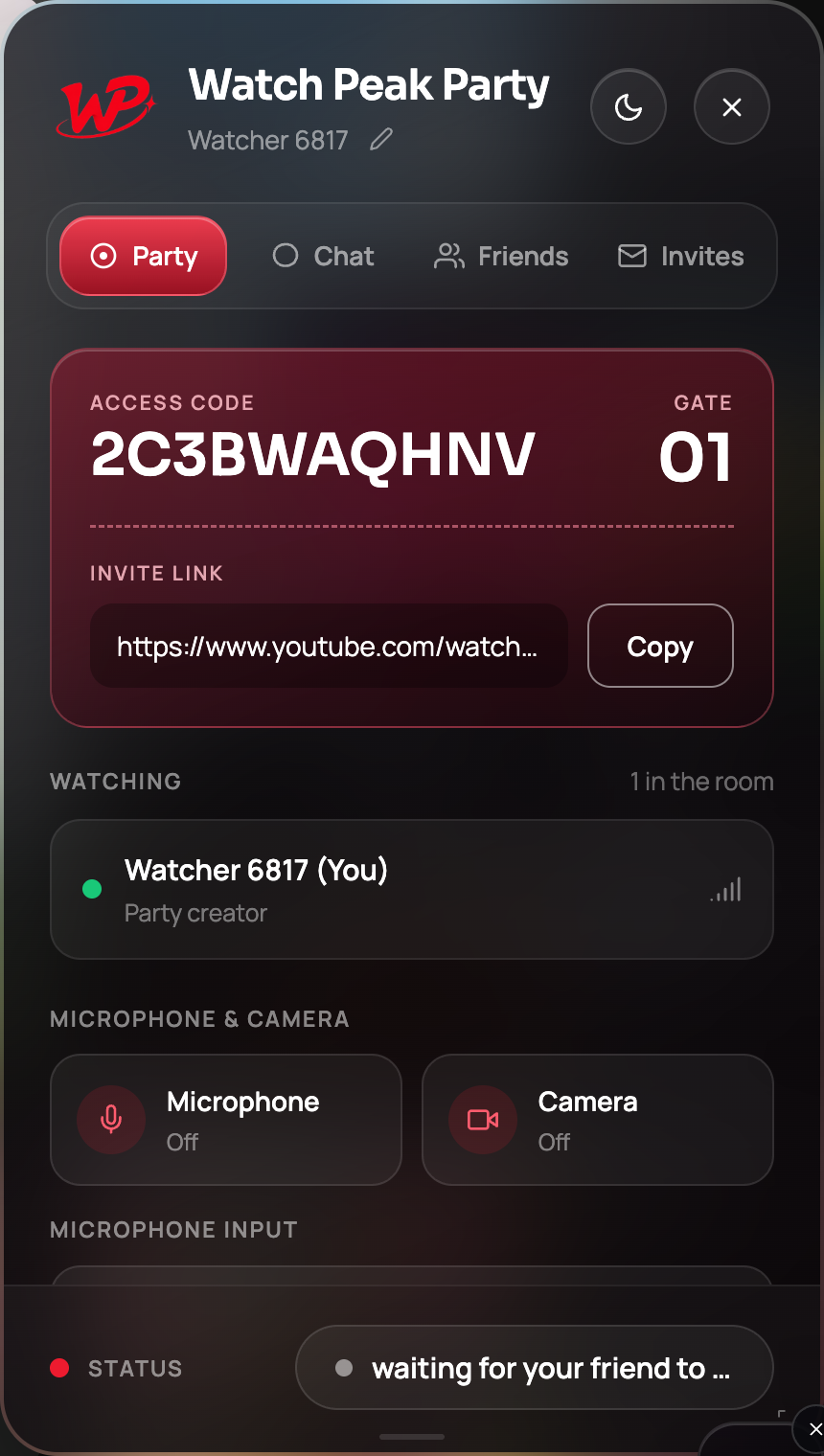
Camera on for the first ten minutes and the last ten. You get the arrival and the conversation afterwards — the two parts where seeing each other actually matters — and the film in the middle stays sharp.
The first ten minutes and the last ten
Do not open with the film. Get in, say hello, sort the technology out, and talk for five minutes first. A film that starts thirty seconds after "hi" makes the whole evening feel like a queue.
Practically: start the party, check you are both in sync with a quick pause, then leave it paused and talk. When you are ready, either of you presses play — there is no host, so nobody has to ask permission.
And plan for after. The conversation once the credits roll is the actual date; the film was the excuse. So do not schedule something immediately afterwards, and do not end the party the instant it finishes.
Small things that prevent the awkward bits
- Do the setup beforehand. Install, reload the tab, test the microphone. Ten minutes of troubleshooting is a bad opening.
- Use headphones. Without them, their microphone picks up their copy of the film and you hear it fractionally offset from yours. This is the single most common thing that makes a virtual film date feel broken.
- Turn off the chat sound. There is a toggle in the Chat tab header. A ping during a quiet scene is worse than a late reply.
- Agree that either of you can pause. Both of you can — no host — and knowing that removes the small anxiety of needing something and not wanting to interrupt.
- Keep the tab in front. Chrome throttles background tabs and the party will drift. Also they can tell.
Common questions
Should we use the camera during the film?
For a comedy it adds a lot; for anything else it is tiring and it competes with the film for bandwidth. Camera on for the first and last ten minutes is a good compromise.
Why do I hear an echo of the film?
Their microphone is picking up their copy of it, arriving slightly offset from yours. Headphones fix it completely.
Who controls playback?
Both of you. There is no host, so either person can pause without asking.
What is the best kind of film for this?
Something with natural gaps — a comedy, a documentary, or something one of you loves and the other has never seen. Avoid subtitles and dense thrillers.
Do we need accounts?
No. A party by link works signed out on both sides. Accounts are only for the friends list.
One link. Same second. No screen sharing.
Watch Peak Party keeps YouTube, Netflix, Prime Video, Crunchyroll, Disney+, Hulu, HBO Max and JioHotstar in sync — with chat, voice and video built in.
Add to Chrome